
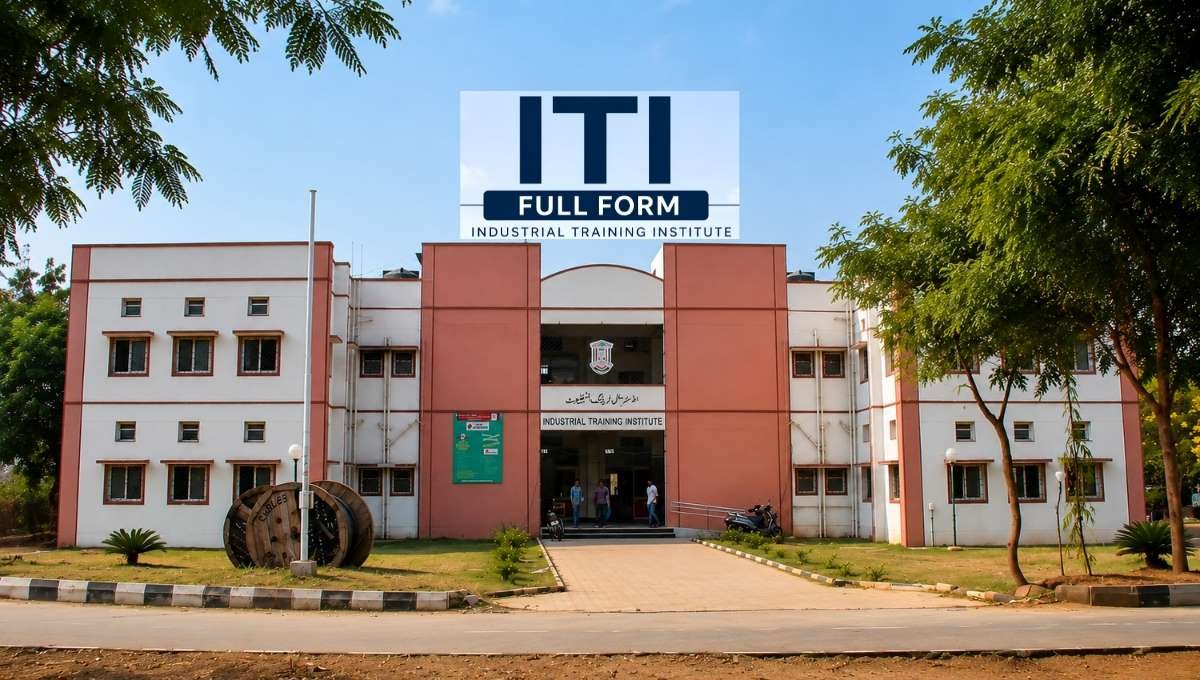
After studying Class 8 and Class 10, one of the most important decisions students have to make is what to do for their careers. A large number of students go on to higher secondary education but some opt for learning a skill which helps them to get a job early. ITI is one of the most popular vocational education programs in India. ITI full form is Industrial Training Institute. These institutes teach different technical and non-technical skills to the students for their job in various industries, manufacturing, construction, automobile and electrical related fields. In this guide, you will get to know everything about ITI full form, eligibility criteria, ITI admission process, course duration, popular trades, career prospects, salary, and difference between ITI and Polytechnics.
What is the full form of ITI?
The full form of ITI is Industrial Training Institute. ITI is a vocational training school set up to train skilled workers in various industries. ITI is different from conventional education as it emphasizes on the practical aspect of the course so that students can be confident to do technical work after finishing the course. More than 100 engineering and non-engineering trades are taught at these institutes. Students get hands-on experience in workshops, laboratory sessions, industrial visits and Apprenticeships. The main aim of the ITIs is to minimize the mismatch between job market needs and skilled manpower through job oriented education.
Key Highlights of ITI
| Particular | Details |
| ITI Full Form | Industrial Training Institute |
| Type of Education | Vocational and Skill Development |
| Managed By | Directorate General of Training (DGT) |
| Ministry | Ministry of Skill Development and Entrepreneurship (MSDE) |
| Eligibility | Class 8 or Class 10 (depending on trade) |
| Minimum Age | 14 Years |
| Course Duration | 6 Months to 2 Years |
| Certification | NCVT or SCVT |
| Admission Process | Merit-based (State-wise) |
| Career Options | Government & Private Sector Jobs |
What is an ITI?
An Industrial Training Institute is a Governmentally recognized institute that offers technical education through skill based courses. The institutes are government and private owned and spread throughout India. The curriculum has been framed as per industry demands, thereby helping the students to get acquainted with the skills rather than the theoretical concepts. On the completion of the course, students are able to either apply for jobs in manufacturing industries, railways, construction companies and automobile workshops, electrical firms, public sector organizations and many other industries or pursue higher education. Numerous ITI graduates also launch their own ventures as electricians, plumbers, mechanics, welders or technicians.
Objectives of ITI Education
The Industrial Training Institutes were instituted for a number of significant purposes.
- Train the skilled human resources for Indian industries.
- Provide affordable vocational education.
- Increase employment opportunities for young people.
- Promote practical learning instead of only theoretical knowledge.
- Help overhaul India’s Skill Development Mission.
- Promote entrepreneurship and self-employment.
- To respond to the need for skilled technicians.
- Due to these goals, there is still a great significance of ITIs in the workforce development of India.
What is the Regulatory Body of ITIs in India?
Industrial Training Institutes are governed by the Directorate General of Training (DGT) which is under the Ministry of Skill Development and Entrepreneurship (MSDE). The DGT establishes the standards for training, updates the courses and approves trades and it guarantees quality education for the institutes.
Students are typically awarded a certificate from any of the following certification systems:
- NCVT (National Council for Vocational Training) – Nationally recognized certification, which is accepted in whole India.
- SCVT (State Council for Vocational Training) – State level qualification that is recognised in the state of issue and accepted by many employers. With the government recognition for private ITIs, many private ITIs also provide NCVT courses these days.
What makes Students opt for ITI?

ITI has become one of the most preferred career options after 10th standard as it provides hands-on training and employment opportunities are available quickly. The benefits are:
- Short-duration courses
- Low fees in Government institutes
- The number of skilled employees is in high demand.
- Better practical exposure
- Apprenticeship opportunities
- Good placement prospects
- Government job eligibility
- Opportunity for self-employment
ITI is also considered as a quicker route to financial independence as compared to several years of traditional degree programs for those students who do not want to wait for several years to complete their degrees.
ITI Courses Available
There are several types of ITI courses available which can be classified into two types according to the types of training.
Engineering Trades
Engineering trades are trades that require technical knowledge, machines, electrical systems, mechanical equipment, manufacturing processes, and industrial maintenance. The courses are mostly prerequisite for students who have learned Mathematics and Science in secondary education.
Some of the most common engineering trades are:
- Electrician
- Fitter
- Welder
- Turner
- Machinist
- Plumber
- Diesel Mechanic
- Air Conditioning & Refrigeration Technician
- Electronics Mechanic
- Mechanic Motor Vehicle
- Wireman
- Tool and Die Maker
Construction companies, railways, power plants and engineering companies typically provide better opportunities for engineering trades, while manufacturing industries do as well.
Non-Engineering Trades
Most non-engineering trades focus on services, office work, design, hospitality, beauty, and tailoring. These less technical fields best suit students interested in service-based careers. There are a number of popular non-engineering trades such as:
- Assistant to a Computer Operator and Programmer (COPA)
- Stenographer
- Secretarial Practice
- Dress Making
- Fashion Design Technology
- Hair and Skin Care
- Food Production
- Sewing Technology
- Interior Decoration
- Health Sanitary Inspector
The courses are for employment in office work, salons, hotels, boutiques, hospitals, and schools and service industries.
ITI Course Duration
An ITI course duration varies according to different trades. The majority of certificate programs offer hands-on training in a relatively brief timeframe.
Here are some typical course lengths:
| Course Duration | Examples of Trades |
| 6 Months | Computer Basics, Short-term Skill Courses |
| 1 Year | Welder, Plumber, Carpenter, COPA, Stenographer |
| 2 Years | Electrician, Fitter, Turner, Machinist, Electronics Mechanic |
Long duration courses usually involve more advanced practical and industrial training, thus giving the student a better chance of being competitive in the job market.
Popular ITI Trades in India
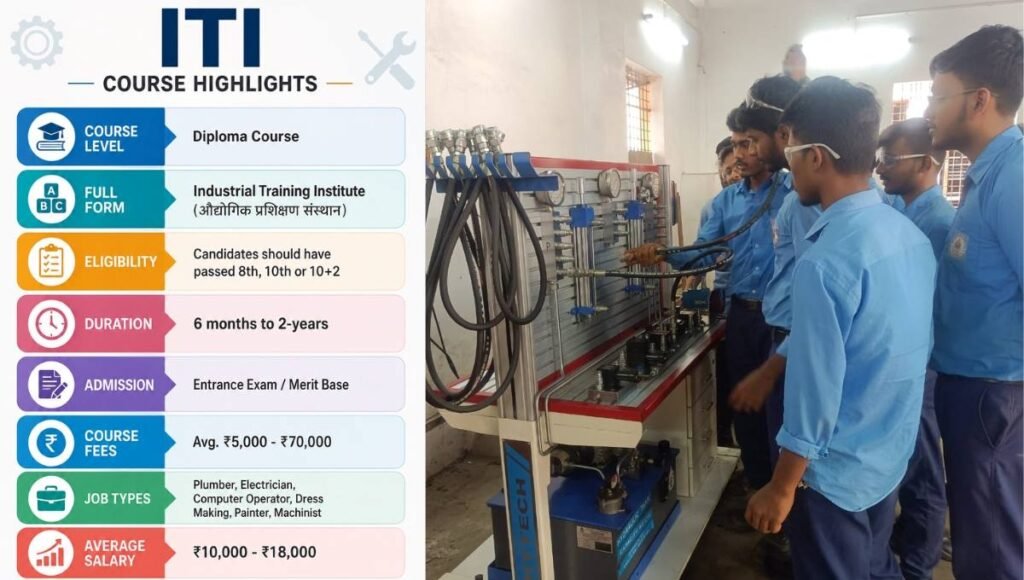
Thousands of students enroll in ITI programs every year, with certain trades consistently ranking among the most popular due to their strong employment prospects. Some of the most sought-after ITI trades include:
- Electrician
- Fitter
- Welder
- Mechanic Motor Vehicle
- Diesel Mechanic
- COPA (Computer Operator and Programming Assistant)
- Electronics Mechanic
- Wireman
- Plumber
- Turner
- Machinist
- Refrigeration and Air Conditioning Technician
These trades offer career opportunities in government departments, manufacturing industries, automotive companies, infrastructure firms, and various private-sector organizations.
If you meet the eligibility requirements, read on to learn about the ITI admission process, government vs. private ITIs, fees, top ITI colleges, and certification options in Part 2.
ITI Eligibility Criteria 2026
Eligibility criteria for ITI admission are different for different trade and different ITI. Most ITIs, however, have a similar set of rules, both government and private institutions.
Educational Qualification
Students are required to have passed Class 8 or Class 10 exam from any recognized board. In general, engineering trades require a class 10 with maths and science while some non-engineering trades accept class 8 pass holders.
Age Limit
Admission is usually at the age of 14. Most states have an age of 40, while age relaxation is provided for reserved categories as per government rules.
Minimum Marks
For admission to ITIs, students are required to get a minimum of 35% marks in the qualifying examination. However, the percentage required may differ from state to state from admission authority to admission authority and from trade to trade.
ITI Admission Process 2026
The admission to Industrial Training Institutes is mainly made through State Level Admission Authorities. Generally, government ITIs have merit-based admission procedures and several private ITIs will provide direct seats depending on the vacancies.
The following steps are used for a general admission process:
- Go to the official website of ITI admission of your state.
- Fill out this online form with your personal and academic information.
- Submit necessary documents, photos and signatures.
- If applicable, pay the application fee on-line.
- To wait for a merit list that has been prepared based on the marks obtained in the qualifying examination.
- Take part in seat allotment and counselling.
- Check original documents at designated institutes.
- Pay admission fee for confirmation of seat.
- Pupils are advised to visit the official website of the ITI of their State/UT on a regular basis for notifications and important dates.
Documents required for ITI admission
The following documents should be brought along to the time of admission:
| Document | Purpose |
| Class 8/Class 10 Mark Sheet | Proof of educational qualification |
| Transfer Certificate (TC) | Previous school record |
| Aadhaar Card | Identity verification |
| Passport-size Photographs | Admission and institute records |
| Domicile Certificate | State quota verification (if applicable) |
| Caste Certificate | Reservation benefits (SC/ST/OBC/EWS) |
| Income Certificate | Scholarship or fee concession (if applicable) |
| Character Certificate | Proof of good conduct |
| Disability Certificate | For PwD reservation (if applicable) |
| Migration Certificate | Required for students from another board/state (if applicable) |
Government ITI vs Private ITI
Many students conduct a contrast of government and private ITIs prior to their application. There are differences in their fees, admission process, and infrastructure, with both providing vocational training.
| Parameter | Government ITI | Private ITI |
| Fees | Low and subsidized | Higher than government institutes |
| Admission | Merit-based | Merit or direct admission |
| Seats | Limited | More seats available |
| Recognition | Mostly NCVT | NCVT or SCVT |
| Placement Support | Good | Depends on institute |
| Infrastructure | Varies by state | Varies by institute |
Generally government ITIs are preferred due to their affordable fees and good recognition and reputed private ITIs offer quality training and placement support as well.
NCVT and SCVT: What’s the Difference?
The students tend to confuse the NCVT and SCVT certifications.
NCVT
NCVT is an acronym for “National Council for Vocational Training”. The courses which are approved by NCVT are recognized nationwide and accepted by various PSUs and government departments and private companies throughout India.
SCVT
SCVT is “State Council for Vocational Training”. They are awarded by states and are accepted primarily in the state in which they are awarded, but many employers will accept them.
Students who want to pursue a career in various states prefer NCVT approved courses.
ITI Course Fees
There are no fixed fees; they depend on the type of institute (whether government or private).
| Institute Type | Approximate Fees |
| Government ITI | ₹1,000–₹10,000 per year |
| Private ITI | ₹15,000–₹60,000 per year |
Apart from tuition fees, students may need to pay for uniforms, workshop materials, examination fees, and hostel facilities where applicable.
Career After ITI
| Career Opportunities After ITI | Government Jobs After ITI | Private Sector Jobs After ITI |
| Electrician | Indian Railways | Automobile Industry |
| Fitter | Public Sector Undertakings (PSUs) | Manufacturing Companies |
| Welder | State Electricity Boards | Electrical Equipment Industry |
| Technician | Defence Organizations | Construction Sector |
| Machine Operator | Public Works Department (PWD) | Steel Plants |
| Automobile Mechanic | BHEL | Cement Industry |
| Plumber | ONGC | Telecom Companies |
| Carpenter | BEL | Electronics Manufacturing |
| Wireman | Municipal Corporations | HVAC Industry |
| Electronics Technician | State Government Departments | Engineering Workshops |
| Computer Operator | Technical Government Posts | IT & Service Companies |
| Service Technician | Apprentice & Skilled Trade Posts | Maintenance & Repair Services |
Expected Salary After ITI
An ITI graduate’s salary would vary based on the trade, employer, experience and location.
| Experience Level | Average Monthly Salary |
| Fresher | ₹10,000–₹20,000 |
| 2–5 Years | ₹20,000–₹35,000 |
| Experienced Professional | ₹35,000–₹60,000+ |
Candidates working in large manufacturing companies, oil and gas industries, or overseas projects may earn significantly higher salaries.
Apprenticeship After ITI vs Higher Education After ITI
| Apprenticeship After ITI | Higher Education After ITI |
| Practical industrial experience | Polytechnic Diploma (Lateral Entry) |
| Monthly stipend | Advanced Training Institutes (ATI) |
| Professional skill development | Crafts Instructor Training Scheme (CITS) |
| Better employment opportunities | Diploma in Engineering |
| Industry exposure | Certification Courses |
| Opportunity for permanent employment | Skill Development Programs |
| Hands-on workplace training | Entrepreneurship Training |
| Improved technical expertise | Higher studies and career advancement |
In addition to tuition fees, there may be uniform, workshop materials, examination fees, and hostel expenses (if applicable) to be paid.
ITI vs Polytechnic: Which is Better?
After Class 10, there is confusion whether to opt for ITI or Polytechnic diploma. It will depend on your career objectives, financial constraints, and the time frame in which you are willing to begin employment.
If you want to learn practical skills and get a job quickly, then it is better to opt ITI. Students who wish to study for higher qualifications later and for engineering related professions are more appropriate for Polytechnic.
| Parameter | ITI | Polytechnic |
| Full Form | Industrial Training Institute | Polytechnic Diploma |
| Eligibility | Class 8 or Class 10 | Class 10 |
| Duration | 6 months to 2 years | 3 years |
| Focus | Practical trade skills | Engineering education |
| Qualification | Trade Certificate | Diploma |
| Career | Technician, Skilled Worker | Junior Engineer, Supervisor |
| Higher Education | Diploma or Skill Courses | B.Tech (Lateral Entry) |
| Job Readiness | Faster | Moderate |
Those who are looking to get jobs in early days opt for ITI and those who are looking to get into Engineering opt for Polytechnic.
Top Government ITIs in India
The Industrial Training Institutes have established a good reputation for providing quality education, updated workshops and placement support.
The following well known government ITIs are:
- Government ITI, Pusa, New Delhi, India
- Morris Gate, Delhi (Government ITI)
- Ch. Brahm Prakash Government ITI, Delhi
- Government ITI, Jahangirpuri, Delhi
- Government ITI, Malviya Nagar, Delhi
- Government ITI, Chennai
- Government ITI, Bengaluru
- Government ITI, Hyderabad
- Government ITI, Mumbai
- Government ITI, Lucknow
Students should always make sure that the institute and trade in which they are planning to apply has the approval of the relevant authorities.
Conclusion
ITI full form is Industrial Training Institute, and it is one of the best ways for students to receive education that focuses on skills and hands-on experience. ITIs offer training that lasts from 6 months to 2 years and equip students for employment in various engineering, manufacturing, construction, electrical, automobile servicing, computer operations, and other industries.
An ITI qualification can be used to build a strong base for securing employment opportunities in the government sector, private sector, starting a business, or for pursuing further education via Diploma Courses. Investing in the right trade and a recognised institute can develop the students with the valuable technical skills to enhance their employability and can provide them with a long-term career prospect in the ever-expanding industrial scenario of India.
Frequently Asked Questions (FAQs)
A1. The full form of ITI is Industrial Training Institute. It offers vocational education and training in technical and non-technical trades.
A2. Children who have passed out Class 8 examinations or Class 10 examinations from any recognized board with appropriate eligibility as per the selected trade are eligible for application.
A3. Length of training varies from 6 months to 2 years, depending on the trade.
A4. Those in search of a job and hands-on experience are good to opt ITI, whereas those in mind to take up engineering studies are better off joining Polytechnic.
A5. Yes. After completion of ITI course, students can apply for many Technical Jobs in Indian Railways, PSUs, Defence Service, Electricity Board, Government organizations, etc. as per their eligibility.
Also Read: SkillCircle – best d Review 2026: Courses, Fees, Placements & Student Reviews