
The full form of PCS is Provincial Civil Service. An administrative or government corps recruited on a state level for positions of importance. PCS officers are appointed by the government and are responsible for administration, execution of government schemes, maintenance of public services and duties at the district, divisional or departmental level. The State Public Service Commission of the respective state holds the recruitment examination. PCS is one of the most sought after careers for the graduates who wish to opt for the civil service and work for the benefit of their respective state. This guide addresses all aspects of PCS including PCS full form, definition, eligibility, examination process, job roles, salary, career growth, and PCS vs IAS.
What is PCS?

PCS is the acronym for Provincial Civil Service. It is a state-level civil service exam in India used to recruit administrative officers for Group A and Group B posts in state government administration. The SPS Commission normally handles the recruitment process. For instance, UPPCS exam is held by Uttar Pradesh Public Service Commission (UPPSC) and Bihar Public Service Commission (BPSC) conducts Bihar state civil services recruitment. PCS officers may be appointed in district administration, revenue department, government secretariats, development departments and other branches of government. The details of their tasks vary with their office, department, rank and their state rules.
PCS Full Form and Meaning
The full form of PCS is Provincial Civil Service. In layman’s terms, PCS is a government job on the state level. Officials who have been appointed through competitive exams are assigned administrative duties and facilitate the government’s policies, administrative problems, and public service. The specifics of PCS vary from state to state. Thus, it is advised to always see the latest notification issued by the State Public Service Commission of the respective state.
The PCS Examination is conducted by the State Public Service Commission of the particular State makes the recruitment of PCS.
| State | Public Service Commission |
| Uttar Pradesh | UPPSC |
| Bihar | BPSC |
| Madhya Pradesh | MPPSC |
| Rajasthan | RPSC |
| Maharashtra | MPSC |
| Odisha | OPSC |
| West Bengal | WBPSC |
| Haryana | HPSC |
| Punjab | PPSC |
There are variations between states regarding the names of the exams, the number of vacancies, syllabus, age limit, number of papers, and selection process.
PCS Eligibility Criteria
The eligibility requirements depend on the state and post. But, there are general requirements that most of the state civil service exams have. A Bachelor’s degree from a recognized university is typically a requirement. Applications may be accepted from any graduate, provided he or she fulfills the requirements of the specific examination. These may include:
- Arts
- Science
- Commerce
- Engineering
- Management
- Law
- Other recognized disciplines
There are certain jobs that may require a particular degree or subject.
Age Limit
Age limit depends on the State PSC & post. The age requirement for most exams is 21 or older; the maximum age is typically 35-40 years. Age relaxation as per Govt Rules are applicable for the Candidates belonging to Eligible Reserved Categories.
PCS Eligibility at a Glance
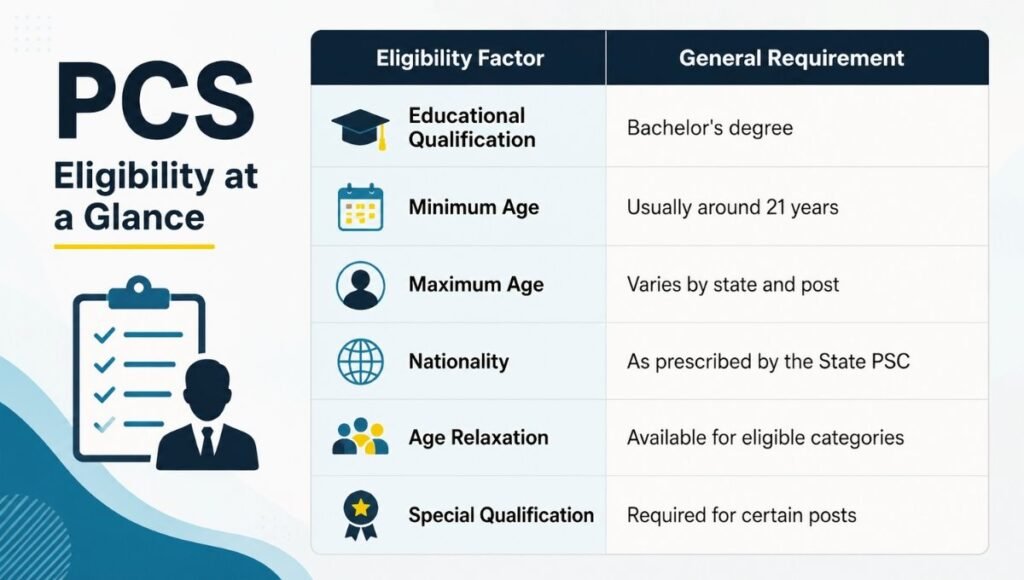
| Eligibility Factor | General Requirement |
| Educational Qualification | Bachelor’s degree |
| Minimum Age | Usually around 21 years |
| Maximum Age | Varies by state and post |
| Nationality | As prescribed by the State PSC |
| Age Relaxation | Available for eligible categories |
| Special Qualification | Required for certain posts |
PCS Examination Process
The PCS selection process generally consists of three major stages:
- Preliminary Examination
- Main Examination
- Face-to-Face or written interview/Personality test
Each State has its own examination format.
PCS Preliminary Examination
The Preliminary Examination is usually an objective type paper to shortlist candidates for further tests. Common subjects include:
- Indian History
- Geography
- Indian Polity
- Indian Economy
- General Science
- Environment
- Current Affairs
- General Knowledge
- State-specific knowledge
In Mental Ability or Aptitude (if applicable), The number of papers, marks, duration, negative marking and qualifying criteria are based on the State PSC.
PCS Main Examination Details
Those who pass the Preliminary Examination are allowed to appear for the Mains Examination. Generally, the Mains stage is descriptive and assesses the ability to explain, analyse and present information effectively. Common areas include:
- Essay
- General Studies
- History
- Geography
- Polity
- Economy
- Ethics
- Current Affairs
- State-specific topics
- Language papers
Where possible, the optional subjects will be listed. The papers and syllabus vary as per the respective state.
PCS Interview Details
If a candidate passes the Mains examination he will be called for an interview or personality test. The interview can evaluate the following:
- Communication skills
- General awareness
- Administrative understanding
- Decision-making
- Leadership ability
- Confidence
- Problem-solving skills
- Knowledge of state issues
- Overall personality
The final selection is according to the rules laid down by the State Public Service Commissions.
PCS Selection Process
| Stage | Purpose | Nature |
| Preliminary Exam | Shortlisting candidates | Objective |
| Main Exam | Detailed assessment | Descriptive |
| Interview | Personality assessment | Oral |
| Final Selection | Preparation of final merit | As per State PSC rules |
Job Roles of a PCS Officer
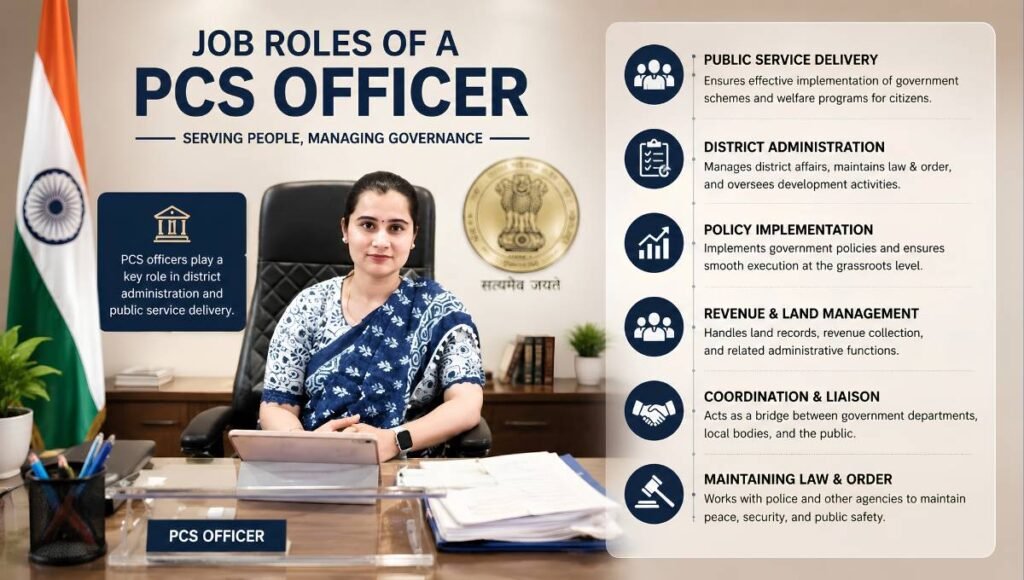
PCS officers are important at various level of administration in the state government. They are assigned duties depending on their assignment and department. Common responsibilities include:
- Implementing government policies
- Supervising government schemes
- Managing revenue-related activities
- Addressing public grievances
- Coordinating development programs
- Supporting election administration
- Managing disaster-response activities
- Conducting inspections
- Maintaining official records
- Linking with government departments
- Monitoring welfare schemes
Field officers are typically working directly with citizens, local authorities, and other government officials.
Common PCS Posts
While post titles vary across states, state public service commissions use the PCS exam to recruit candidates for a variety of administrative roles.
| Post/Role | Main Responsibility |
| Deputy Collector/SDM | Sub-divisional administration |
| Assistant Commissioner | Departmental and administrative work |
| Revenue Officer | Revenue and land-related administration |
| Development Officer | Implementation of development programs |
| Administrative Officer | Government department management |
| Other State Services | Department-specific responsibilities |
Salaries of PCS Officers
The salary of PCS is subject to change based on the state, post, pay level, allowances and government rules applicable to it. Hence, there is no fixed salary for all the PCS officers in India. The PCS officer may be awarded:
- Basic salary
- Dearness Allowance (DA)
- House Rent Allowance (HRA)
- Travel-related allowances
- Other government benefits
Generally, the pay, responsibilities and administrative powers of officers increase in tandem with their experience and advancement in rank. The candidates should read the latest recruitment notification regarding the pay scale and allowances for each of the posts under PCS.
Career Progression After PCS
Opportunities for Career growth through promotions and selection based on state service rules are available with PCS. A simplified career-path might be:
“PCS Officer (promotion) → Senior Administrative Position (promotion) → Higher State Government Position (promotion) → Senior Administrative Responsibilities (promotion)”
Specific terms and conditions for designations and promotions differ by state. There is also a selection/ promotion system for induction of experienced State Civil Service officers into the IAS. But this is not automatically true for all the PCS officers that become IAS officers. The eligibility, vacancy, service record, seniority and applicable rules are critical.
Career Opportunities after PCS
PCS officers can serve in various positions across the state administration.
| Area | Typical Work |
| Revenue Administration | Land and revenue-related matters |
| District Administration | Local administration and coordination |
| Development | Government schemes and development projects |
| Public Grievances | Handling citizen complaints |
| Disaster Management | Relief and emergency coordination |
| Elections | Administrative support during elections |
| Government Departments | Policy implementation and supervision |
| Welfare Programs | Monitoring public welfare schemes |
PCS vs IAS
Both PCS and IAS are prestigious civil services, but they have different recruitment systems and career structures.
| Parameter | PCS | IAS |
| Full Form | Provincial Civil Service | Indian Administrative Service |
| Recruitment | State Public Service Commission | UPSC |
| Level | State | All India |
| Examination | State PCS Examination | UPSC Civil Services Examination |
| Posting | Mainly within the state | State and Central Government |
| Service Type | State Civil Service | All India Service |
| Competition | Primarily state-level | National-level |
| Career Scope | Mainly state administration | State and central administration |
| Major Roles | State administrative positions | District, state and central administrative positions |
| Promotion | Higher state posts; possible IAS induction | Higher IAS positions |
PCS vs IAS – Which is better?
There’s no right or wrong answer since the two services are designed for different career objectives. The candidates who wish to get a career in All India Service, opportunities with the Central Government and wider administrative exposure may prefer IAS. PCS might be a better option for individuals who wish to pursue a career mostly at the state level and are most interested in working with the State level administration. History, Geography, Polity, Economy, Environment, Current Affairs etc. are some of the important subjects required to be prepared for both examinations. In addition to these requirements, candidates preparing for the PCS exam need a strong command of the state’s history, geography, economy, government schemes, and current affairs.
Conclusion
PCS is an important state level civil service of India which is referred to as Provincial Civil Service. PCS officers partake in administrative, revenue, development programs, public welfare, disaster management and execution of government policies.
The selection process typically consists of Prelims, Mains and Interview, depending on the state. The expected basic educational qualification is a bachelor’s degree and age limits and other requirements vary by individual State PSC.
FAQs
A1. The full form of PCS is the Provincial Civil Service.
A2. Yes. PCS is a civil service of the State Government.
A3. Usually requires bachelor’s degree (according to the rules of the relevant State PSC).
A4. The State Public Service Commission is usually responsible for conducting PCS examinations.
A5. Yes, a PCS officer may be considered for induction into IAS through the promotion-selection process provided the rules applicable to the process, vacancies and eligibility