
KCET, also known as the Karnataka Common Entrance Test, is a state-level entrance examination conducted by the Karnataka Examinations Authority (KEA). The exam provides admission opportunities to eligible students seeking undergraduate courses in engineering, technology, agriculture, pharmacy, and other professional fields in Karnataka. Students who want to pursue BTech and other eligible courses in Karnataka can use KCET as an important admission route. Every year, thousands of students appear for the Karnataka Common Entrance Test to secure admission to colleges across the state. Candidates preparing for KCET should understand the eligibility criteria, application process, exam pattern, syllabus, important documents, and counselling procedure before applying. This article explains everything students need to know about KCET, including eligibility requirements, subjects, preparation tips, application procedures, results, and counselling.
What Is KCET?
The Karnataka Common Entrance Test is an entrance examination conducted by the Karnataka Examinations Authority for admission to various professional undergraduate courses in Karnataka. The examination primarily evaluates students’ knowledge of subjects studied at the Pre-University Course (PUC) or Class 12 level.
KCET is particularly important for students who want to pursue engineering and technology courses through the state admission process. Eligible candidates can also seek admission to certain agriculture, pharmacy, and other professional programmes covered by the examination and the applicable admission rules.
| Particulars | Details |
| Exam Name | Karnataka Common Entrance Test |
| Popular Name | KCET |
| Conducting Authority | Karnataka Examinations Authority (KEA) |
| Exam Level | State Level |
| Exam Mode | Offline, using an OMR-based answer sheet |
| Main Purpose | Admission to eligible professional undergraduate courses |
| Major Courses | Engineering, technology, agriculture and pharmacy-related programmes, subject to applicable rules |
| Main Subjects | Physics, Chemistry, Mathematics and Biology, depending on the course |
| Application Mode | Online |
| Examination Mode | Pen-and-paper examination |
| Admission Process | Examination, merit preparation and counselling, as applicable |
| Official Website | cetonline.karnataka.gov.in/kea/ |
KCET 2026 Important Dates
KCET candidates should keep track of important dates to avoid missing registration deadlines, examination announcements and counselling activities. The KEA may revise its schedule, so students should verify the final dates through official notices.
| Event | KCET 2026 Schedule |
| Application Process | January 2026 onwards |
| Admit Card | April 2026 onwards, subject to the revised schedule |
| Entrance Examination | April–May 2026, as per schedule revisions |
| Answer Key | After the examination |
| Result | June 2026, subject to official updates |
| Counselling | June onwards |
| Seat Allotment | According to the counselling schedule |
KCET 2026 Eligibility Criteria
Before applying for KCET, students must confirm whether they meet the academic and other eligibility requirements for their desired courses. The eligibility criteria can differ based on the programme, category and applicable admission conditions.
Nationality
Candidates tend to need to be Indian citizens to qualify for government-seat admissions under the relevant KCET eligibility criteria. However, particular provisions can apply to selected candidate categories. Students should examine the official information bulletin before applying.
Educational Qualification
Candidates with the aim to gain admission to engineering courses tend to need to pass Class 12 or the equivalent examination with Physics and Mathematics as compulsory subjects, plus an eligible additional subject as per the admission criteria. For agriculture and other courses, the required subjects may vary. Students should confirm the eligibility criteria for their selected programme before deciding on their relevant subjects during registration. Candidates appearing for their qualifying examination may also apply where the applicable criteria allow them to do so. They need to satisfy the prescribed qualification requirements for admission.
Minimum Marks
Engineering candidates tend to need at least 45% aggregate marks in the relevant qualifying examination subjects if they belong to the general category. Candidates belonging to eligible reserved categories may get a relaxation, commonly to 40%, under the applicable criteria. Students should ascertain the exact subject combination, qualifying examination requirements, and category-based conditions in the KCET 2026 information bulletin.
Karnataka Eligibility Conditions
KCET is closely linked to Karnataka’s professional education admission system. Candidates with the aim of securing government-quota seats tend to need to satisfy at least one of the eligibility clauses specified by KEA. These clauses can involve educational history, schooling in Karnataka, parental circumstances, or other conditions prescribed by the state government. Passing the examination does not necessarily make a candidate eligible for every category of seat.
Students from other states should thoroughly examine the eligibility clauses before applying. They should not assume that appearing for KCET automatically grants access to all government-quota seats.
KCET 2026 Application Form
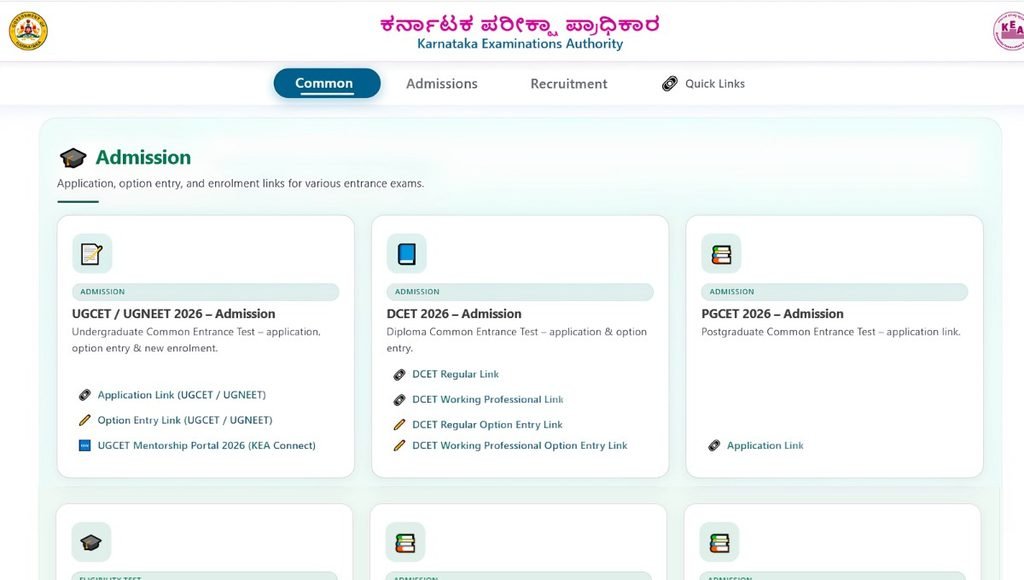
The KCET application process is handled online via the Karnataka Examinations Authority website. Candidates should ensure that they enter their details correctly and follow the instructions given in the official notification. The application process tends to involve registration, filling in personal and educational information, selecting relevant options, paying the fee, and submitting the form.
How to Apply for KCET 2026
Follow these steps to understand the general application procedure:
- Step 1: Visit the Official Website. Access the Karnataka Examinations Authority website at cetonline.karnataka.gov.in/kea/.
- Step 2: Find the KCET Registration Link. Look out for the KCET or UGCET application link for the relevant admission year. Open the link and read the instructions given carefully.
- Step 3: Complete Registration. Enter the required information, such as the name, date of birth, contact details, and other requested particulars.
- Step 4: Fill Out the Application Form. Provide the educational details and other information required by the application portal. Ensure that the information entered matches your official documents.
- Step 5: Upload Required Documents. Upload the photograph, signature, and other documents in the prescribed format wherever required.
- Step 6: Pay the Application Fee. Pay the applicable examination fee via an applicable online payment method. The fee depends on the candidate’s category and other conditions specified by KEA.
- Step 7: Review and Submit. Check every detail before submitting the form. Inaccurate information may lead to issues during verification or admission.
- Step 8: Save the Confirmation Page. Download or print the submitted application and payment confirmation for future reference.
Candidates should keep in mind that completing registration does not guarantee admission. They need to meet the eligibility conditions and complete the remaining examination and counselling procedures.
KCET 2026 Application Fee
The application fee depends on the candidate’s category and the applicable conditions for the examination year. Candidates should refer to the fee structure issued by KEA rather than relying on unofficial information. The fee can differ for general-category applicants, reserved-category candidates, and applicants from other states. Additional conditions can apply to particular categories.
Students should pay the fee before the prescribed deadline and retain the payment receipt. They should also check if the payment status appears correctly on the application portal. If a payment fails or the application status remains unclear, candidates should follow the official instructions for resolving the issue. They should refrain from making duplicate payments without first checking the transaction status.
KCET 2026 Exam Pattern
Elaborating on the KCET exam pattern can help students prepare efficiently and utilise their time well during the examination. KCET employs an offline, objective-type examination format. Candidates mark their answers on an OMR sheet as per the directions given by the examination authority.
The following table outlines the typical examination structure.
| Subject | Questions | Maximum Marks | Duration |
| Physics | 60 | 60 | 80 minutes |
| Chemistry | 60 | 60 | 80 minutes |
| Mathematics | 60 | 60 | 80 minutes |
| Biology | 60 | 60 | 80 minutes |
Candidates usually take the required subjects to pursue their desired course. Engineering aspirants mainly take Physics, Chemistry, and Mathematics whereas those applying for eligible agriculture and related programmes may require Physics, Chemistry, and Biology or other prescribed subject combinations.
Each subject paper usually consists of 60 multiple-choice questions. Candidates get one mark for every correct answer, and there is generally no negative marking for wrong answers in the KCET pattern. Students should still check the instructions for the relevant year prior to the examination.
Is There Negative Marking in KCET?
KCET generally does not have negative marking for wrong answers. Candidates get one mark for every correct answer; however, for incorrect answers and those they leave blank, marks are not awarded. While this system allows students to attempt questions strategically, they should read each question carefully and refrain from marking multiple options for one question. Candidates should strictly adhere to the instructions on the OMR sheet, as incorrect marking methods can affect evaluation of their answer sheets.
KCET 2026 Admit Card
The admit card for KCET is an important document that students must bring along to the exam centre. KEA releases admission tickets through its official website per the examination schedule. Candidates should download their admit cards as soon as they become available and check all the details printed on. Steps to download their admit card:
- Go to the official website of KEA.
- Access the link for the KCET 2026 admission ticket.
- Enter the required login credentials.
- Submit the information and access their admit card.
- Check name, registration, and examination details.
- Download and print out the admit card.
Candidates should check the examination date, reporting time, and centre details on the admit card. If they find any errors, they should reach out to KEA through the official support channels. Students should also read the instructions printed on the admit card. They should bring along the required identification documents and adhere to the examination centre’s regulations.
KCET 2026 Result
The result of KCET determines a candidate’s performance in the entrance examination. KEA publishes the result and related merit information on its official website. Candidates should use their login credentials or the details requested by the result portal to access their results. Students can follow these steps to check their results:
- Go to the official website of KEA.
- Access the KCET result link.
- Enter the required registration or login details.
- Submit the information.
- Check the result displayed on the screen.
- Download or print the result for future reference.
Candidates should verify marks and other details upon downloading the result. As per KCET guidelines, they should also take on official announcements regarding merit ranks, document verification, and counselling.
What Happens After the KCET Result?
Once results are announced, eligible candidates may proceed with the admission process as instructed by KEA. The next steps may include document verification, checking the merit list, entering college preferences, and seat allotment. Students should keep in mind that a good score does not guarantee admission to a specific college or branch but rather depends on factors such as rank, eligibility, seat availability, reservation rules, and choices entered during counselling.
KCET 2026 Counselling Process
KCET counselling helps eligible candidates acquire seats in participating colleges and courses. KEA carries out the counselling process according to applicable admission rules and the released schedule. Candidates should complete the required formalities within the prescribed deadlines. Steps in KCET Counselling:
- Document Verification: Candidates must complete the applicable document verification process. They should keep their original documents or copies ready.
- Registration and Login: Eligible candidates must access the counselling portal and complete the required registration or verification.
- College and Course Selection: Candidates can enter their preferred colleges and courses through the option-entry facility. They should make arrangements for their preferences according to their interests, expected rank, course availability, and budget.
- Seat Allotment: KEA processes the entered preferences according to merit rank, eligibility, reservation rules, and seat availability. Candidates can check allotment results through the official portal.
- Acceptance of the Allotted Seat: Candidates must follow the instructions applicable to their allotted seat. Depending on the available choices, they may need to confirm acceptance, pay the prescribed fee, or participate in a subsequent round.
- Reporting to the College: Candidates who complete the required admission formalities must report to the allotted institution within the prescribed deadline.
Students should read the counselling instructions carefully before making decisions. They should check the regulations regarding preference change, seat acceptance, participation in later rounds, and cancellation of admission.
Documents Required for KCET Admission
Candidates should prepare documents prior to counselling to avoid unnecessary delays. The following documents may be required based on the candidate’s eligibility category and course:
- KCET admission ticket
- KCET result or rank information
- Class 10 marks card
- Class 12 or PUC marks card
- Transfer certificate
- Study certificates (if applicable)
- Caste certificate (if applicable)
- Income certificate (if applicable)
- Kannada language or eligibility-related documents (if required)
- Valid identity proof
- Other certificates specified by KEA
The exact document requirements can differ for candidates. Students should refer to the official counselling notification to confirm the documents they must submit.
KCET 2026 Preparation Tips
A well-planned preparation can help candidates improve their performance in KCET. Students should focus on understanding concepts, practising questions, and revising important topics.
- Understand the Syllabus: Start by reviewing the official syllabus for Physics, Chemistry, Mathematics, or Biology, depending on one’s desired course. Divide the syllabus into smaller topics and set up a realistic study schedule.
- Study Textbooks Thoroughly: As KCET questions are based mainly on the Karnataka PUC syllabus, students should understand the concepts prescribed in the textbook. Avoid skipping important chapters unless they are deemed irrelevant for the examination.
- Practise Previous-Year Papers: Previous-year question papers help students understand the question pattern and improve their problem-solving speed. They also help identify topics that require additional practice.
- Take Mock Tests: Attempt mock tests under timed conditions. After each test, review mistakes and identify the concepts to improve on.
- Revise Regularly: Set aside time for revision throughout one’s preparation. Make short notes covering important formulas, chemical reactions, definitions, and difficult concepts.
- Improve Time Management: Practise solving questions within the available time. Learn how to recognise straightforward questions and avoid spending too long on one difficult question.
- Check Official Updates: Follow KEA announcements for examination instructions, syllabus changes, answer keys, results, and counselling. This helps avoid reliance on outdated information.
Conclusion
KCET is an important entrance examination for students looking to get admission to engineering, agriculture, and other eligible professional undergraduate courses in Karnataka. Understanding eligibility criteria, syllabus, examination pattern, application procedure, and counselling process can help students prepare effectively.
Students should understand the prescribed syllabus, practise previous-year questions, take regular mock tests, and revise important concepts. They should keep their documents ready and follow the official admission schedule. For updated information about KCET 2026, including examination updates, results, and counselling, visit the official Karnataka Examinations Authority website. Always check the eligibility requirements and admission instructions before making decisions.
Frequently Asked Questions
A1. KCET stands for Karnataka Common Entrance Test. It is conducted by the Karnataka Examinations Authority for admission to eligible undergraduate professional courses in Karnataka.
A2. The Karnataka Examinations Authority conducts KCET and manages the related admission process according to the applicable rules.
A3. KCET is an important admission route for eligible engineering candidates seeking seats through the Karnataka state admission process. However, other admission routes and eligibility requirements may apply to particular institutions or seat categories.
A4. KCET generally awards one mark for each correct answer and does not deduct marks for wrong answers. Candidates should check the examination instructions for the relevant year.
A5. The main subjects are Physics, Chemistry, Mathematics, and Biology. The subjects a candidate needs to take depend on the course and the applicable admission requirements.
Also Read: CUET PG 2026: Eligibility, Exam Date, Application Form, Syllabus, Exam Pattern and Admission Guide